

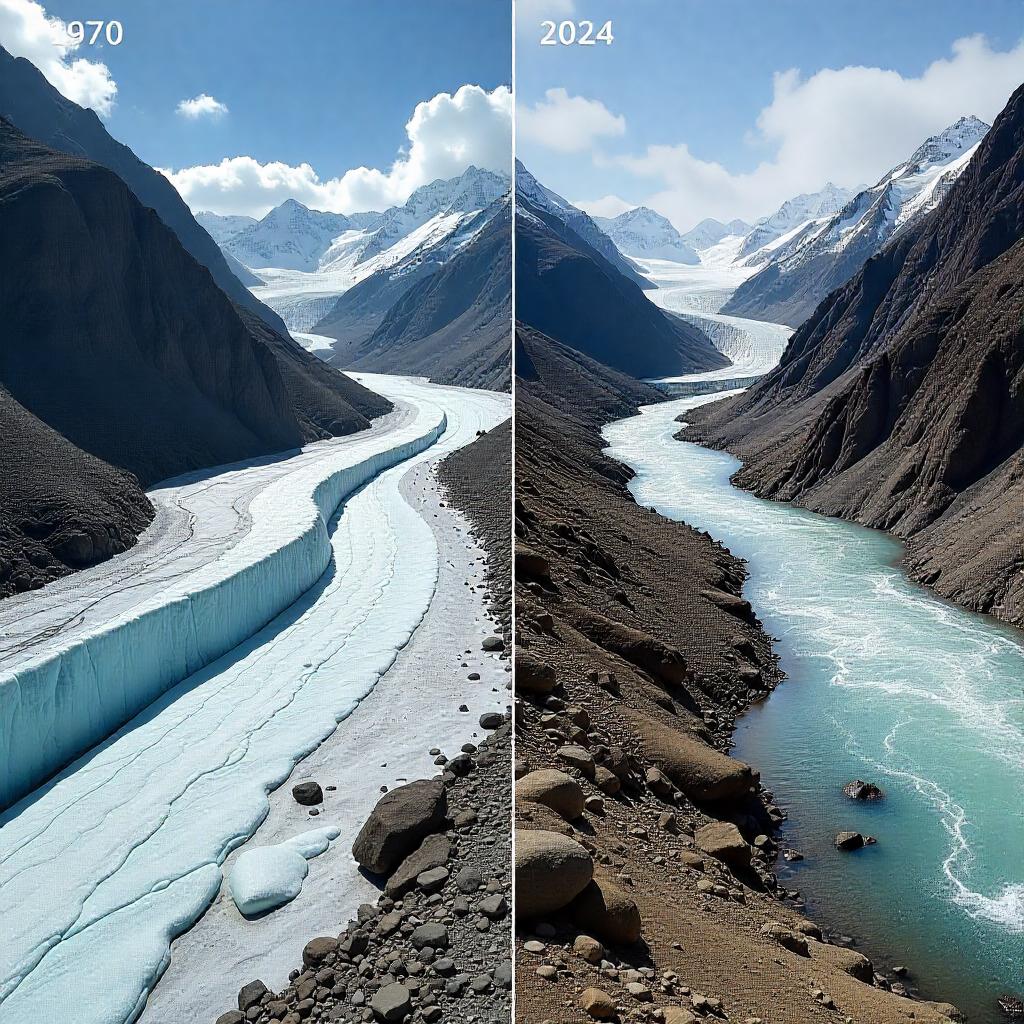
Effects of Glacier Retreat on Ganga, Brahmaputra, and Indus— Three Key Rivers
For Indian families, rivers run in many ways Our rivers are not simply water bodies—it is life’s blood that has built cultures, supported agriculture, and cradled billions of lives for thousands of years. The Ganga, which is worshipped as a goddess and considered the lifeblood of the plains of northern India, supports more than 400 million people with its water. The great Brahmaputra that creates an unbroken chain of lush valleys and ridges Utah-sized, running through the Northeast, determining the ability for millions of people, biodiversity, and ecosystems to thrive. The Indus, twisting through today’s northwestern provinces and into Pakistan, has long sustained rich agricultural societies, cradling the agricultural origins of one of humanity’s earliest civilizations.
Yet today, these magnificent rivers find themselves under a completely unprecedented threat—one aiming, quite literally, to cut off their source—the retreating glaciers of the Himalayas. As glaciers around the world recede under the impact of our warming planet, the Himalayan “Third Pole” is melting quickly. This process endangers the water security of almost 2 billion people who rely on these glacier-fed rivers. This is not only an environmental issue, but a humanitarian crisis in slow motion impacting every farmer who is still waiting for irrigation water, every child who has to walk a greater distance to access safe, clean drinking water, and every family whose future relies on these great rivers.
Getting to Know the Retreat of the Glaciers
Think about placing a giant ice cube in a warm room, where it is forced to melt. This is pretty close to what’s happening to our Himalayan glaciers, on a scale so big it’s hard to even fathom. Glacier retreat is when glaciers lose more ice from melting than they receive from accumulating new snow and ice. It’s the same as if our ice were a bank account and we were living in a world where withdrawals every year are far more than deposits, resulting in a slow but steady draining of the ice account.Image by Sharon E. Cathcart via Flickr
The Himalayas contain some of the most vital glaciers on the planet. The Gangotri Glacier, the source of the Ganga River, is over 30 kilometers long. Consider it as nature’s water battery—in summer months, the glacier discharges meltwater, replenishing the river, while in winter months, it stores winter snowfall, transforming it into water during warmer seasons.
In a like manner, the Siachen Glacier, one of the longest glaciers in the world outside the polar regions, feeds directly into the Indus River system. For the Brahmaputra, dozens of glaciers spanning the Himalayas and the Tibetan Plateau unite like a team of frozen rivers to supply the river, with each contributing an essential part to an intricate, interdependent hydrological system.
These glaciers serve as nature’s time-release capsules, holding water in the form of ice during colder periods and releasing it slowly over time as the climate heats up. In recent years, rising global temperatures have upset this sensitive equilibrium, triggering glaciers to lose water faster than they can gain it. This trend has accelerated dramatically in recent decades.
The Glaciers Today
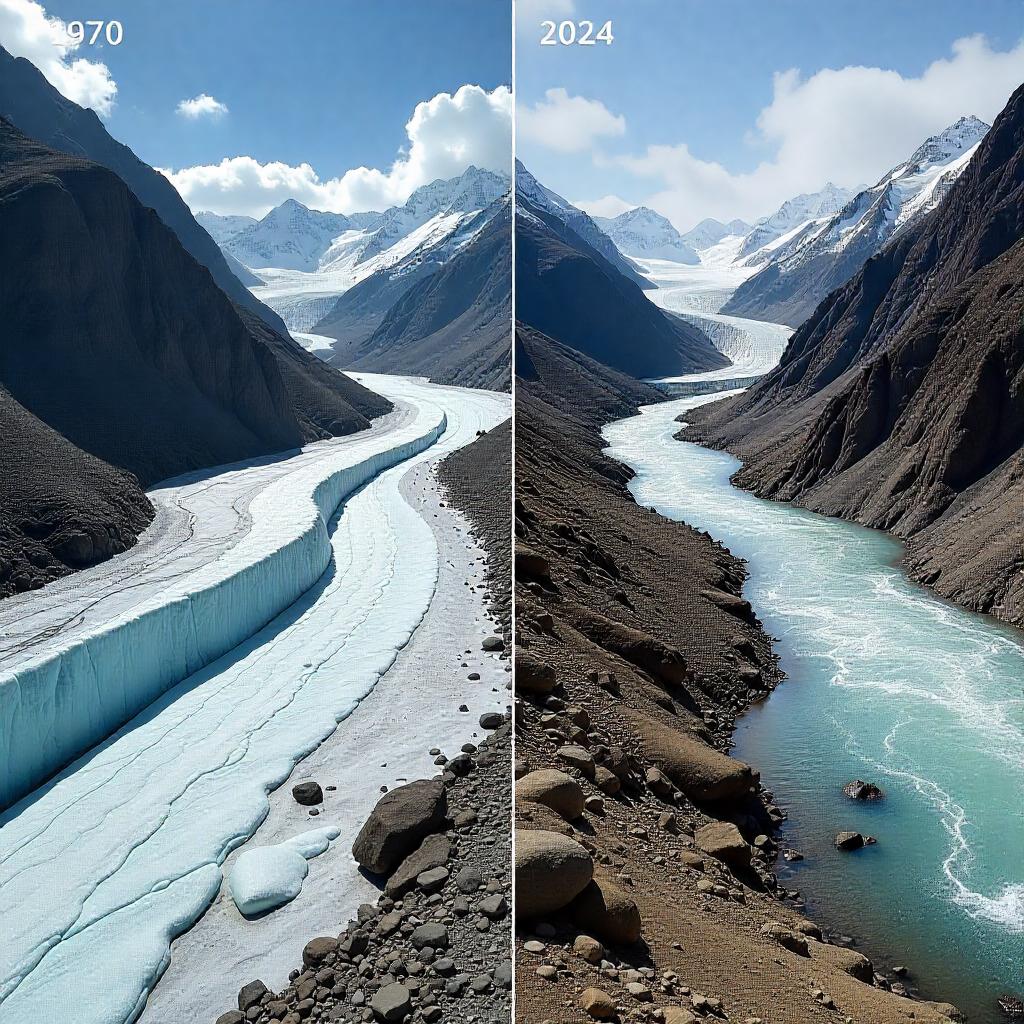
These figures tell a chilling story about the fate of our Himalayan glaciers. The current rate of retreat is 22 metres per year for the Gangotri Glacier, a stark contrast from historical averages. Data for the last 61 years (1936–96) gave total recession of Gangotri glacier as 1147 m, with an average rate of retreat of 19 m per year. Over the past 25 years into the 21st century it has pulled back over 850 meters (34 m/yr).
Recent new peer-reviewed studies from early 2024 indicate even more alarming trends. In general the rate of retreat for the Gangotri glacier over this past decade has been in the range of 12 to 13 metres annually, though this depends heavily on seasonal conditions and various local climatic factors. Over just the past ten years, the glacier has retreated by about 130 meters —more than a football field’s worth of glacier melting away each year.
The larger reality goes far beyond single glaciers, however. Recent climate projections suggest that Himalayan glaciers could lose 75 percent of their ice by 2100. It’s not just concerning the loss of ice, it’s the underlying indication of a much broader shift in how these river systems will operate over the next few decades.
Climate change is causing glaciers in the Himalayas to melt at a faster rate, threatening water supplies across the Ganges, Brahmaputra, and Mekong river basins. Indian glaciers are retreating quickly across the entire Himalayan region, with rates varying from glacier to glacier but exhibiting a definitive increase since the 1970s.
What makes these statistics so shocking isn’t just the number of crashes, the pattern of acceleration. Gangotri has been receding since 1780, though research indicates its rate of retreat accelerated post 1971. This acceleration corresponds precisely with the time of the greatest industrial growth and greenhouse gas emission, emphasizing the clear link between human activity and glacial retreat.
Actual Effects to the Rivers
Not only does the retreat of Himalayan glaciers play a highly variable, locally-determined role in causing both positive and negative impacts on hydrology, it creates a tipping of river systems producing storms and droughts eroding rivers’ ability to endure stable water availability patterns long pre-dating human civilization. In the case of the upper Indus basin, glacier melt can provide as much as 41 percent of the total runoff. For the upper Ganga basin, 13 percent. And for the upper Brahmaputra, 16 percent. These percentages correspond to billions of liters of water on a daily basis. Water that communities, agriculture, and ecosystems all rely on.
The Indus River system is hit the hardest, as it is highly dependent on glacial meltwater. Loss of glacial melt water with continuing glacial retreat would affect the Indus basin more than the Ganga and the Brahmaputra as the former has higher reliance on glaciers. Even through the crucial pre-monsoon months of April to June when agricultural water demand is highest, the Indus must draw on glacial meltwater to sustain any flow at all.
For the Ganga, the effect is less visible but no less alarming. The river is seeing what scientists refer to as the “glacial paradox”—at first, with more glacial meltwater, flows increase, but as glaciers diminish from the landscape this propped-up flow is no longer possible. As the people of these communities living along the Ganga have experienced, changes in seasonal flow patterns are already becoming evident, with some tributaries running dry months earlier than seen in previous years.
As the least uncomplicated instance reaction pattern, the Brahmaputra, supplied by 6 glacier systems in excess of the Himalayas First with flooding, and then ironically, lack of water in the form of extreme variability, our river system has become a poster child for climate change effects. At times of peak melting, the release of too much water can result in catastrophic flood risk. The loss of glacier mass means diminished water supply when it’s needed most in dry seasons.
These changes have serious implications not only for the quantity of water that reaches our communities but for its quality and timing. Glacial meltwater usually delivers the freshest, most mineral-laden water to these respective rivers. With glaciers receding, rivers are relying more on such sources as degraded surface runoff and groundwater, impacting not only the quality of water supply but its predictability.
Case Study Solutions to Diverse, Real-World Challenges Experienced by Community-Based Organizations
The abstract concern of glacier retreat hits home when seen through the lens of communities, whose lives are connected to these rivers. In the villages of Uttarakhand, where the Ganges starts its journey down from the Himalayas, farmers such as Ramesh Chandra have seen all that switch of their lifetime. “Thirty years ago, our village spring never ran dry, even in the peak of summer,” says 65-year-old farmer Ramesh. Fast forward to April, and we’re now having to walk two kilometers to get water for our families and livestock.“Pedestrian and bicycle safety advocates have fought long and hard for Complete Streets policies and practices.
Water Shortages in Dry Seasons Though difficult to measure, anecdotal evidence suggests that even in the plains, springs for communities across the Himalayan foothills tell stories of drying up earlier and earlier every year. In Himachal Pradesh and Uttarakhand, tap water supplied to villages formerly buffered by perennial glacier-fed streams experiences extreme scarcity from March to June. Women and children especially feel the impact of this crisis, they are forced to spend hours each day walking further distances to retrieve water, time they used to spend in school or pursuing work, on a lost opportunity to acquire an education or earn an income.
In the remote Ladakh region, where the Indus River starts, farmers are dealing with the opposite problem. The old irrigation systems, known as “kuhls,” were built based on the rhythms of reliable, yearly cycles of glacier melt. “Our forefathers designed these channels after hundreds of years’ experience of knowing when the glacier water would arrive,” explains Tenzin Norbu, a farmer from Leh. Today the water arrives too soon, when we don’t need it, and not enough when our crops are parched.Image via Communications Design + Illustration Co., CC BY-NC 2.0
The other side of the coin from western water scarcity is the danger of sudden, devastating floods. For years now, communities along the mighty Brahmaputra in Assam have faced increased severity and frequency of flooding. The river’s course has turned more erratic and dangerous, as rushing waters suddenly flood fields, houses, and bridges in minutes.
Meera Devi, a resident of a village near Guwahati, remembers the 2022 floods, “The river increased in height so suddenly, we had no time to salvage our things. Our rice fields—the ones that were not in the path of evacuees—were developed just as they were about to go to harvest. We lost an entire year’s operating revenue in one night.” These kind of incidents are increasingly frequent as glacial lake outburst floods (GLOFs) are on the rise from rapid glacier retreat.
The foundation of Indian agriculture—rice, wheat, and other mainstay crops—are likewise mostly reliant on a steady flow of water from these rivers. In Punjab and Haryana, India’s breadbasket heartlands, farmers are experiencing dwindling groundwater due to a greater reliance on tube wells to make up for diminished river flow in key growing seasons.
“As the cost of diesel for water pumps has doubled, we are spending twice as much on irrigation. For starters, enforcement has been cost prohibitive. It is out of reach for most small farmers. We’re getting worse crop failures and even when we do harvest successfully, we’re harvesting less because that water stress is impacting the quality of our crops.Academy of Fine Arts Vienna | Photo by Jeffrey Johnson
For aquaculturists in West Bengal, many of whom farm fish on the Ganga’s floodplains, challenges abound. Lower water levels in the dry season can increase concentrations of pollutants, causing fish kills and smaller catches. This has a devastating impact on both our commercial fisheries and subsistence fishing communities that rely on the river for their everyday protein source.
3 Health and social impacts—Waterborne illnesses Water scarcity often requires communities to rely on unsafe water, significantly increasing rates of waterborne diseases. In remote Himalayan villages, when a water crisis strikes and children are forced to drop out of school, it’s often the girls who are kept from school, as they’re needed to help on the often-arduous task of water collection. This deepens generational cycles of poverty and denies access to life-changing educational opportunities.
As a family physician working in India’s Rishikesh region, Dr. Priya Sharma explains that, “In the dry months, we experience a 40% rise in diarrhea, typhoid, and other waterborne diseases. Families are left with no choice but to use contaminated water sources when their traditional sources of clean water dry up.We’re dreaming big and looking to expand our delegation of practitioners and innovators so that we can get more fresh ideas and fresh talent into the pipeline.
The psychological impact is just as severe. Indigenous communities that have kept close spiritual and practical ties to rivers for millennia now find their future tenuous. Indigenous understanding of river flows, learned over centuries and handed down like the waters’ own history, feels new-agey and romantic when the cycles are overturned by climate change.
Government and Non-Governmental Organization Responses
Understanding the gravity of the glacier retreat crisis, the Indian government and many non-governmental organizations have introduced a variety of programs to respond to the both the immediate and long-term effects. These vary from large-scale infrastructure development to grassroots conservation initiatives.
The Ministry of Earth Sciences has launched the National Mission for Sustaining the Himalayan Ecosystem (NMSHE) under the National Action Plan on Climate Change. The mission is aimed at Himalayan glacier science, including early warning systems for glacial lake outburst floods, and adaptive river management approaches. The mission provides support for monitoring more than 2,000 glacial lakes in the Himalayas on a regular basis, with a focus on those that are found to be potentially hazardous.
The Indian Space Research Organisation (ISRO) has played a key role in glacier monitoring with the use of satellite technology. Their ongoing observation program monitors rates of glacier retreat, changes in ice thickness, and the development of new glacial lakes. This information is essential for water resource management and disaster mitigation.
The state of Uttarakhand has introduced the “Spring Revival Program” (Dhara Vikas Programme) that aims at recharging traditional water sources with the involvement of the community. The initiative has restored more than 365 springs in the state, assuring safe water availability to rural communities. “Our strategy is a mix of traditional wisdom and new methods,” says environmental activist Dr. Anil Joshi, who is part of the initiative. “We’re not merely recharging springs; we’re restoring the relationship between people and their water source.”
The government of Himachal Pradesh has initiated the “Him Dhara” program, under which money is given to communities for water harvesting and water conservation projects. Both individual and collective efforts at local levels are recognized by the scheme as needed for adaptation to shifting glacier behavior.
NGOs have also been instrumental in fulfilling the human aspects of glacier retreat. The non-profit organization HESCO (Himalayan Environmental Studies and Conservation Organization) based in Dehradun collaborates directly with mountain communities to establish climate-resilient water management practices. They have assisted more than 200 villages with water conservation methods that diminish reliance on glacial meltwater.
Equally, the Aga Khan Rural Support Programme (AKRSP) has been operating in Ladakh to assist communities in coping with shifting water availability patterns. Their strategy involves the introduction of drought-resistant crops, making irrigation more efficient, and diversifying alternative livelihoods that use less water.
Research organizations such as the Wadia Institute of Himalayan Geology and the G.B. Pant Institute of Himalayan Environment and Development are undertaking essential research on glacier-river interactions. Policy-making and the public are informed about their findings, which provide insight into changes that communities can anticipate in the next few decades.
Collaborations across international boundaries have also developed, with bodies such as the International Centre for Integrated Mountain Development (ICIMOD) working to share knowledge between nations in the Himalayan region. Its Hindu Kush Himalaya Assessment presents detailed analysis of the impacts of glacier retreat along the whole mountain range.
In spite of all this, there are challenges that remain large. Financing for long-term monitoring and adaptation efforts is usually inadequate, and the magnitude of the problem calls for continued attention over several decades. Moreover, most efforts have the difficulty of extending to remote communities where the effects are greatest but access is restricted.
Conclusion
The melting of Himalayan glaciers is one of the most critical environmental issues facing the world today, with far-reaching consequences beyond the mountainous terrain that these ice behemoths call home. The Ganga, Brahmaputra, and Indus rivers—the lifeline for close to 2 billion people—stand at a crossroads with an uncertain future as their glacial origins erode. The effects are not theoretical figures but lived experiences for millions whose lives are literally dependent on these rivers.
From the Punjab farmer fretting about unreliable irrigation water to the people of Assam with rising flood threats, the impacts of glacier retreat permeate all walks of life in the Indian subcontinent. The economic stakes are breathtaking, impacting agriculture, energy generation, and water security in several countries.
Yet, the governmental, NGO, and community response attests to the strength and resilience of human societies. The programs under way—ranging from sophisticated satellite surveillance to old-fashioned spring revival initiatives—demonstrate that solutions can be achieved when we integrate scientific expertise with community knowledge and political will.
Call to Action:
Preservation of Himalayan glaciers and the rivers they irrigate is not merely an environmental necessity; it is a survival issue for half a billion people. Each of us can help in this cause:
Use renewable energy: Cut down carbon footprint by opting for clean energy
Water conservation: Practice water-saving measures in daily life
Community involvement: Join local initiatives to conserve water
Policy support: Vote for political leaders who lead on climate action
Education and awareness: Share knowledge about glacier retreat and its impacts with others
The challenge is enormous, but so is our collective capacity to address it. The glaciers that have sustained civilizations for millennia deserve our protection, not just for their intrinsic value, but for the future of all life they support. The time for action is now—before the retreat becomes irreversible and the consequences become insurmountable.
We are the guardians of these rivers and glaciers. It is our responsibility to save them. Future generations will not judge us by what they inherited but rather by what they did, the solutions they deployed, and what they left behind. Let us make sure we leave a legacy of hope, action, and sustainable stewardship of these precious natural gems.
Links and References
For those who would like to learn more about this, the links below are self-explanatory:
Research Reports and Papers:
Climate Change and Water Resources in India – Report by Government of India
Retreating Glaciers and Himalayan Water Flows: Implication for Governance – Research Report by Observer Research Foundation
NASA Earth Observatory: Retreat of the Gangotri Glacier
Monitoring and Sources:
World Glacier Monitoring Service (WGMS) – Database of global glacier change
Indian Space Research Organisation (ISRO) – Glacier monitoring based on satellite
Wadia Institute of Himalayan Geology – Monitoring and research on glaciers
Conservation Agencies
Himalayan Environmental Studies and Conservation Organization (HESCO)
International Centre for Integrated Mountain Development (ICIMOD)
Aga Khan Rural Support Programme (AKRSP)
Government Programs:
National Mission for Sustaining the Himalayan Ecosystem (NMSHE)
Spring Revival Program – Uttarakhand Government
Him Dhara Scheme – Himachal Pradesh Government
The narrative of glacier retreat and its effect on our rivers is finally a human story—one that plays itself out in the everyday lives of millions of individuals throughout the Indian subcontinent. We invite readers to respond with their own stories, observations, or concerns regarding water availability and river condition within their communities.
Have you observed shifts in nearby water sources? Are there customary traditions in your community that assist with water conservation? Do you have suggestions for ways communities can more effectively adjust to shifting water availability?
Your opinion counts in this discussion. Join the conversation in the comments below, and let’s begin a community discussion regarding climate change and river conservation. Together, we can raise awareness, inspire action, and strive toward solutions to preserve these critical water sources for generations to come.
Recall, each drop saved, each voice heard, and each move made brings us nearer to a world that is sustainable and the great rivers of India keep flowing for generations.
Read about more about Why Water Conservation Is Critical in India’s Future – What You Can Do 2025?

